
A drive fails from underneath. So does a patio, a path and the turning circle by the garage. What sits under a hard surface, what moves the price, and the two consents worth settling before anyone digs.
External works covers driveways, parking and turning areas, footpaths and patios; kerb lines, channels and edging; the falls and gullies that keep water off a building; the levels around a finished house; and ground preparation for planting. On commercial ground it widens into estate roads, yards, car parks and line marking.
We work across Buckinghamshire: Gerrards Cross and Beaconsfield at the middle of it. The patch is set out here. Long private drives, unadopted roads, mature trees tight to the works, a great deal of clay-with-flints. None of it shows in a price per square metre. All of it decides the build-up.
We also take on insurance repair work: a drive that has sunk, cracked or lifted, or been damaged, and needs putting right after a claim. If your insurer or loss adjuster needs a quote, send us the details and we will price it the same way as any other job.
What is really under a drive
We price the part nobody photographs. Under the block paving or the resin is a depth of compacted stone, put in and rolled in layers, and its depth is a decision. It is taken off the ground we find when we dig, the loading the drive will actually see, and whether water is meant to pass through it or run off it. Get that decision wrong and no surface on earth saves the job.
The trimmed ground it sits on is the formation, and it decides as much as the stone does. Soft spots are dug out and replaced, not bridged. On clay a geotextile membrane goes down at that level so the stone cannot punch its way into wet ground and disappear.
Then stone by the layer. A rule of thumb for a car drive is at least 150mm of compacted sub-base, and the word carrying the weight is compacted. A plate only densifies so far down. Tip the whole depth in as one heap and you get a firm crust over a soft middle that settles for years. Two lifts, each compacted before the next, and it is solid all the way down. Nobody can inspect that afterwards, which is where a cheap quote is cheap.
Nobody ever admires a sub-base. It is still the only part of the job that decides how the rest of it ages.
Resin-bound driveways
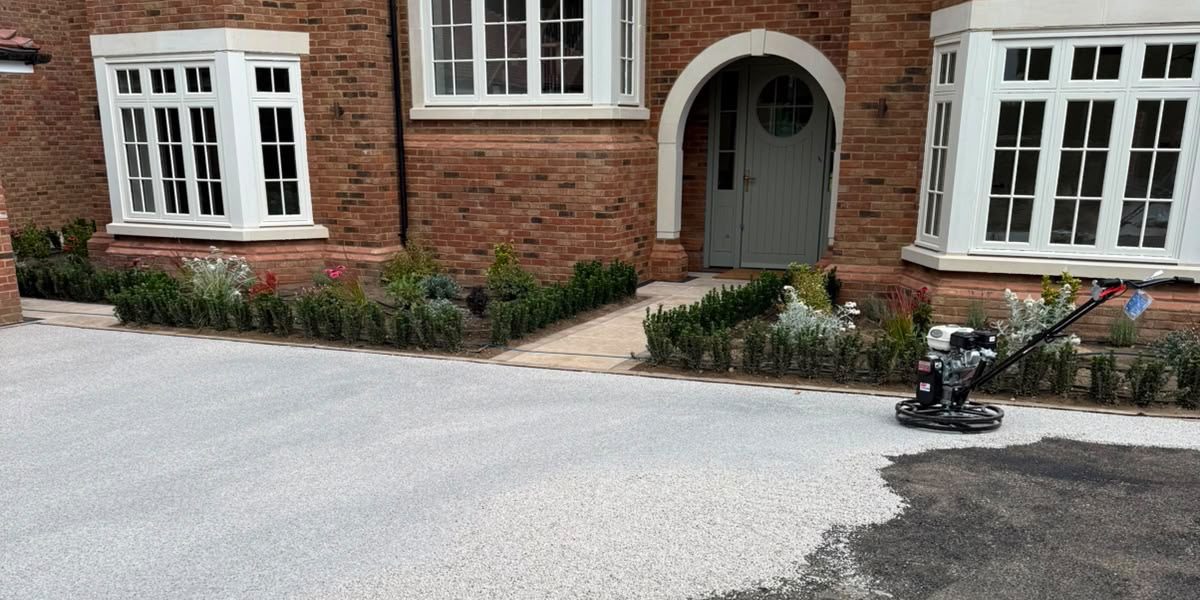
Resin-bound gravel is the surface most people ask us for by name, and it is the one that punishes a poor base hardest. The aggregate and the resin are mixed on site in a forced-action mixer, batch by batch, and the mix is barrowed out and trowelled flat by hand before it goes off. There is no second attempt at a batch.
It goes down over a solid base, normally asphalt or concrete, at around 15 to 18mm for a drive. Lay it over something that moves and the surface cracks along whatever moved underneath it, because the resin holds the stone together far better than it bridges a gap. That is why most of the days on a resin job are spent on the dig, the stone and the edges, and why the black arrives so late in the programme.
Laid over an open-graded base, it can be permeable, which matters at the front of a house where impermeable surfacing over about five square metres generally needs planning permission. Our driveway guide goes through the surfaces side by side and the rules that come with each.
Edges are what hold it all together
Every hard surface pushes outwards. Gravel migrates, blocks creep, tarmac crumbles at an unsupported edge. Kerbs and edging are the restraint that stops all of it. They are also the lines the eye reads first, so a wandering edge spoils a good surface.
A kerb line is set out from string lines and levels, bedded on concrete and haunched behind, a wedge up the back of the unit taking the sideways push. Leave the haunch out and the kerb leans within a couple of years, pulling the surface with it. Channels do the rest, gathering water at the foot of a kerb or across a garage threshold and walking it to a gully. Edging and drainage are one system, and both go in before the surface.
Falls, gullies and where the water ends up
Anything hard has to shed water somewhere deliberate: a gentle cross fall, roughly 1 in 40 to 1 in 60 as a rule of thumb, always away from the building, and lengthways falls carrying water to a gully. Flat is not a finish. Flat is a puddle that freezes.
Where it goes next is a design question. A soakaway works where the ground will take it, and on the stiffer clays it often will not. A soakage test settles that, not assumption. Permeable construction still works on clay. It stops being soakage and becomes storage, the stone holding the downpour and letting it out slowly. Surface water never joins the foul drain. More in our drainage guide.
WORTH KNOWING
In England, surfacing more than about five square metres of a front garden in something impermeable generally needs planning permission, unless the run-off is directed to a permeable area inside your own boundary. Permeable construction, or a fall into a lawn or border on your own land, usually keeps the work within permitted development. Replacing an existing surface counts towards the area, and conservation areas change it again. Put it to your local planning authority before anything is ordered.
Getting a car across the footway
One thing worth settling before we quote: how you get onto the drive. Crossing a footway or verge needs a licence from the highway authority, and it is nothing to do with planning permission. People are regularly surprised to have won one and still be unable to start. We will tell you plainly whether your entrance needs it, and we work to whatever specification the authority sets.
The authority judges it on its own terms: sightlines, footway width, whether there is room to turn inside the plot rather than reverse out blind. It can refuse. As a rule the works are carried out by the authority or a contractor approved by it, at the householder’s cost, and a new access onto a classified road generally needs planning permission too. Fees and timescales vary, so ask yours early.
Paths, patios and the ground around a house
Beside a finished building, levels are everything. As a rule of thumb a hard surface against a wall sits a good 150mm below the damp-proof course and falls away from the wall, not towards it. A patio laid too high bridges that course and walks moisture into the brickwork. A common and expensive piece of well-meant landscaping.
Paths and patios are a drive scaled down: dig to formation, prove it, compacted base, falls set, edges restrained. Steps and level changes want proper foundations, not sand and good intentions. Where turf or planting follows, the ground is prepared for it. Topsoil to a workable depth, subsoil not left rolled into a pan.
How the work runs, and what moves the price
Set out, and protect what stays
Levels off a fixed datum, usually the damp-proof course. Tree protection fencing up, existing surfaces covered, services located, before anything with tracks moves.
Dig to formation
Out to the depth the build-up needs, spoil leaving as it comes. Anything soft turns up now, while it is still cheap.
Prove it, then build the base
The trimmed ground compacted and checked, membrane where needed, then stone by the layer with each lift compacted before the next.
Edges, channels and drainage
Kerbs and edge courses bedded and haunched, gullies and channel drains set to the finished level, the outfall connected, all before the surface.
Surface, then reinstate
The layer everybody pictures is the quickest stage on site. Then line marking where it is wanted, covers reset flush, protected areas made good.
What moves the number is rarely the surface:
- How much comes out and where it goes. Muck-away is often the biggest line on the sheet.
- Access and machine size. A drive a 5-tonne machine can reach is not the job a side gate makes it.
- Length of kerb and edging, and whether it is straight, radiused, or built to take lorries.
- Levels and trees. A slope wanting steps and retaining, or roots that force hand digging.
ASK ANY CONTRACTOR
- What depth of sub-base, and is it compacted in layers?
- Membrane at formation, and if not, why not on this ground?
- Where does the rainwater end up, and has the ground been tested?
- Are the kerbs and edgings haunched in concrete?
- Is the dropped kerb in this price, and who applies for it?
External works is the last package on site and the first one anybody judges, which is what makes it easy to rush. It sits at the end of a long sequence. Ducts, drainage and levels all had to be right months earlier for the drive to be simple now. The rest of it is on our services page; reading a groundworks quote helps if prices are already in front of you.
Long drives, private roads and tight lanes make this work local. There is more on each of these.
Planning something on your own plot?
Request a Quote