Between the day the diggers arrive and the day the first brick is laid, the most important work of your build happens — and then disappears from view. Here is the whole sequence, and why each stage matters.
Read the Guide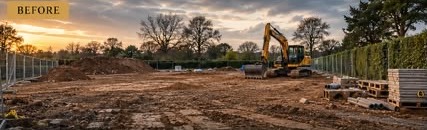
Strip, trench-fill, raft or piled — what each one is, why the ground chooses between them, and why nobody honest answers “how deep?” over the phone.
Water Rules EverythingWhere the rain goes is one of the first questions a build has to answer — and the ground under South Buckinghamshire doesn’t always give the answer you’d like.
First ImpressionsThe surface is the last thing to arrive and the least of the decisions. What a lasting driveway is really made of — and the rules on rainwater worth settling before anyone digs.
Local KnowledgeGerrards Cross and Beaconsfield sit under some of the tightest planning layers in England. Here is what each one actually restricts — and what it doesn’t.
Straight TalkingTwo quotes for the same hole in the ground can be a long way apart. The difference is rarely the digging — it’s what each contractor has chosen to write down.
Going DeeperWhere land is dear and the planners guard every roofline, the only way left to grow a house is often straight down. Here’s what a big dig actually involves — and what to ask before anyone breaks ground.
The things people ask us before they pick up the phone — answered plainly, in four short chapters.
We work across Buckinghamshire and the surrounding counties — including Gerrards Cross, Beaconsfield, the Chalfonts, Amersham and the villages around them. If you’re not sure whether we cover your area, just ask.
Both. We take on groundworks for private homeowners, architects, main contractors and commercial developers — from a single driveway to a full development package. You don’t need to be “in the trade” to work with us.
The site address, a rough idea of what’s being built, and drawings if you have them — even rough sketches help. If you have an architect or structural engineer, we’re happy to work directly with them.
It depends on the programme at the time — but you’ll get an honest answer up front. Once a start date is agreed, you get a programme with your quote, and if anything moves it, you hear it from us first. We reply to enquiries within one working day.
Almost always: site strip, setting out, excavation and muck-away, foundations, drainage, oversite and floor structure, service trenches, then external works. Each stage exists to protect the one after it, which is why the order barely changes from one house to the next.
Groundworks is a dirty trade done properly — or a disaster done badly. We plan machine sizes and deliveries around your access, protect drives and surfaces, keep roads clean, work sensible hours, and keep neighbours informed. On the streets we work in, that matters as much as the work itself.
It’s normal for this part of the world, and we plan for it — root protection, sympathetic working methods, and making sure the right permissions are in place before any ground is broken. See our guide to building in South Buckinghamshire.
Yes — green belt policy restricts new houses on open land, but extensions are generally possible where they are proportionate to the original house, and a replacement dwelling where it is not materially larger than the one it replaces. What counts is set by local policy, so check with Buckinghamshire Council early. Our South Bucks guide explains what each designation actually restricts.
The working limit is the root protection area — as a rule of thumb, a circle with a radius of twelve times the trunk diameter. Digging inside it usually needs a method statement agreed with the council, using hand digging, air-spade work or no-dig construction.
Usually, yes — even without a tree preservation order, most tree work in a conservation area needs six weeks’ written notice to the council first. Sizes and exemptions vary, so confirm with the local planning authority before anyone starts.
Tell us about the project — the quote form asks the right questions — and we’ll talk it through with you, visit the site where needed, and give you a clear, itemised written quote. No jargon, no hidden extras, no hard sell.
It’s a stated allowance for work that can’t be priced until the ground is opened — a soft spot, an unknown drain, whatever sits under the old drive. Far from being a dodge, it’s usually a sign of an honest quote; one with no provisional sums on unopened ground is simply quieter about the same risk. Our guide to reading a groundworks quote explains how a provisional sum should convert into a real, evidenced figure.
Dug soil takes up more room than it did in the ground — as a rule of thumb, a quarter to a third more once loosened — and it leaves site by the lorry-load, charged per load and more for clay or contaminated material. If a quote has no muck-away line, the cost hasn’t vanished; it just hasn’t been written down yet.
Ask to see the public liability insurance certificate rather than just being told it exists, ask who will actually be on site day to day, and agree in advance how surprises in the ground get priced — in writing, before money is spent. Payments should be staged against completed work, not front-loaded before a machine arrives.
Yes — fully compliant, on every job. (Insurance details to follow.)
There is no standard answer — depth depends on the soil, nearby trees and the water table, and building control confirms it at the open trench, not over the phone. Our foundations guide explains why.
Both start with the same trench. Strip puts a layer of concrete in the bottom with masonry built up off it; trench-fill fills the trench with concrete almost to ground level — quicker, and nobody has to work down the hole.
On shrinkable clay, tree roots dry the ground and make it shrink, so foundations within a tree’s influence must go deeper or move onto piles. Removed trees count too — the clay can swell back for years afterwards.
Foul water is everything from inside the house — toilets, basins, appliances — and goes to a sewer for treatment. Surface water is rain off roofs and paving, and the two must be kept in separate systems the whole way.
Often not. In England, as a rule of thumb, a permeable surface — or one draining to a lawn or soakaway within your own boundary — usually counts as permitted development, while paving more than about five square metres with an impermeable surface that drains to the road is likely to need permission. Check with your local planning authority before any work starts.
On a properly built base any of them can last for decades; on a poor one, none will. Choose on looks, drainage and the amount of maintenance you’re happy to live with.
The sub-base — the compacted stone below the surface. It carries the load; the surface only finishes the job. Our driveway guide explains what a proper build looks like, layer by layer.
Almost certainly, yes. As a rule of thumb, excavating within roughly three metres of a neighbour’s structure — or roughly six metres for deeper digs — triggers formal notice under the Party Wall Act, and your party wall surveyor will confirm exactly what applies. Our basements guide walks through it in plain English.
The British Standard describes three forms of defence — a barrier membrane, a structure built to resist water, and a drained cavity with a sump and pump — and combining two of them is common practice. A specialist waterproofing designer chooses the mix for your ground; see our basements guide for the plain-English version.
Ask us directly — a question costs nothing, and you'll get a straight answer either way.
Get in Touch